

Specialized Electrolux Appliance Repair in San Francisco
Mon–Sat: 8:00 AM – 7:00 PM
Cookies brown on one side, cakes sink, and roasts finish at odd times. Learn what makes an oven drift off its set heat, what you can test yourself, and when to book.
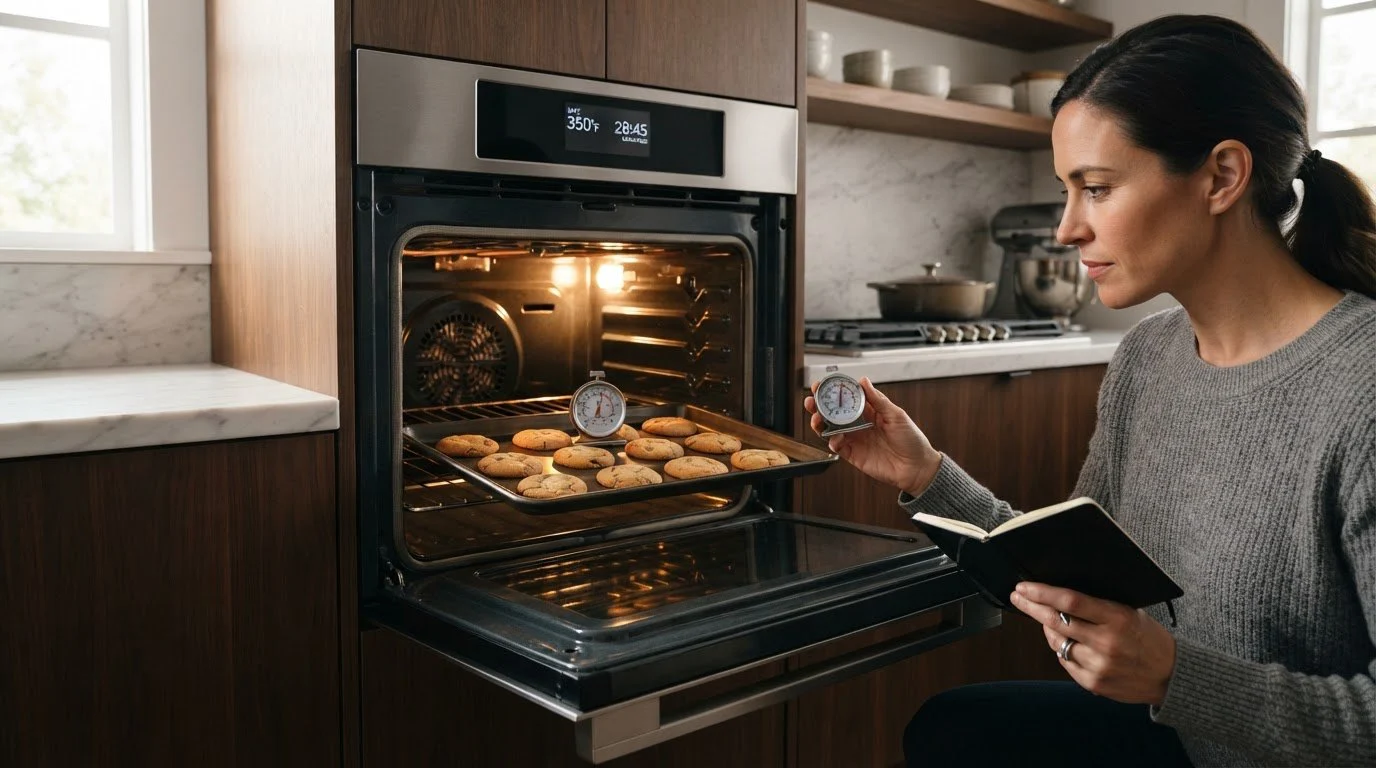
Baking exposes oven problems quickly. A cake that rises on one side, cookies that scorch in a hot spot, a roast that is done well before the recipe says it should be. Nobody expects a wall oven to hold one exact number, because the heating elements switch on and off to keep the cavity inside a band. The question is whether the band has widened enough to wreck results. This article helps you work out whether you are seeing normal cycling, a habit in how the oven is used, or a fault.
As the oven heats, it overshoots a little and then coasts back down while the element is off. Preheat indicators and the first chime can come before the whole cavity, walls and racks included, has soaked up heat. Putting food in right at the signal often means the first stretch of baking runs cooler than the setting, and the later stretch runs hotter. Waiting a bit longer after the preheat signal evens it out for many recipes. That is a technique, not a fault.
The control relies on a sensor inside the cavity to decide when to switch the element. If the sensor drifts, the control chases the wrong number. A sensor that fails outright shows up as F30 for an open probe or F31 for a shorted one, but one that is only slightly off can show no code at all, which is the harder case.
Check the gasket around the door for flattened, torn or shifted sections. A gap lets heat leak out, so the oven works harder and swings wider.
On models with convection, a fan that has slowed or stopped leaves hot spots. The result is uneven browning even when the average temperature is right.
An element that does not heat fully, or only part of it, produces long recovery times and uneven heat. You may see a glowing element with dark patches, or an oven that takes much longer to come up to heat.
The relays that switch the elements can stick or fail, and the control board can mis-time the cycles. The code F10 is listed for thermal runaway, meaning the oven reached heat it should not, and any appearance of it ends the question of whether to keep baking.
Do not adjust anything inside. If your control offers an offset setting in the user menu, your owner guide explains it, and a technician can tell you whether it is the right tool for what you found.
The ECWS3012AS is a single oven with an Air Sous Vide mode, which is a general Electrolux feature name for cooking at gentle, held heat. In that kind of mode, drifting temperature matters even more because the point is steady heat. The oven and microwave combinations ECWM3012AS and ECWM3011AS share a cabinet with a microwave above or below, which can affect cooling and venting around the oven.
Book if the test shows large swings or a steady offset, if a probe code appears, if the gasket is damaged, or if the oven heats unevenly even after you adjust your habits. Give us the model number from the frame of the oven and tell us what you cooked and how it turned out. That description helps a technician decide whether to start with the probe, the fan or the elements.
We diagnose first, give a written estimate, and work only with your approval. See Electrolux wall oven repair or browse Electrolux wall ovens. If your fan keeps running after use, our article on the oven cooling fan may help.
Yes. The elements switch on and off to hold a range around the set heat. It becomes a problem when the swings show up in your food or the oven runs far from the setting.
A probe code such as F30 or F31 points directly at it. Without a code, a thermometer test showing a steady offset or large swings suggests the sensor, though a technician confirms it.
Some controls offer an offset in the user menu, described in your owner guide. That adjusts the display, not a failing part, so it is not a fix for real swings.
Uneven browning can come from crowded racks, pan type, rack position or a convection fan that is not moving air. A slow fan is worth reporting.
Yes. F10 is listed as thermal runaway. Switch the oven off and book a visit before baking again.
Share a few details and we’ll confirm an appointment. Prefer to talk? Call us and we’ll help right away.