

Specialized Electrolux Appliance Repair in San Francisco
Mon–Sat: 8:00 AM – 7:00 PM
A steady thump that follows the drum's rotation is a mechanical clue, not a random noise. Learn which parts create it, what to check from outside, and when to stop the dryer.
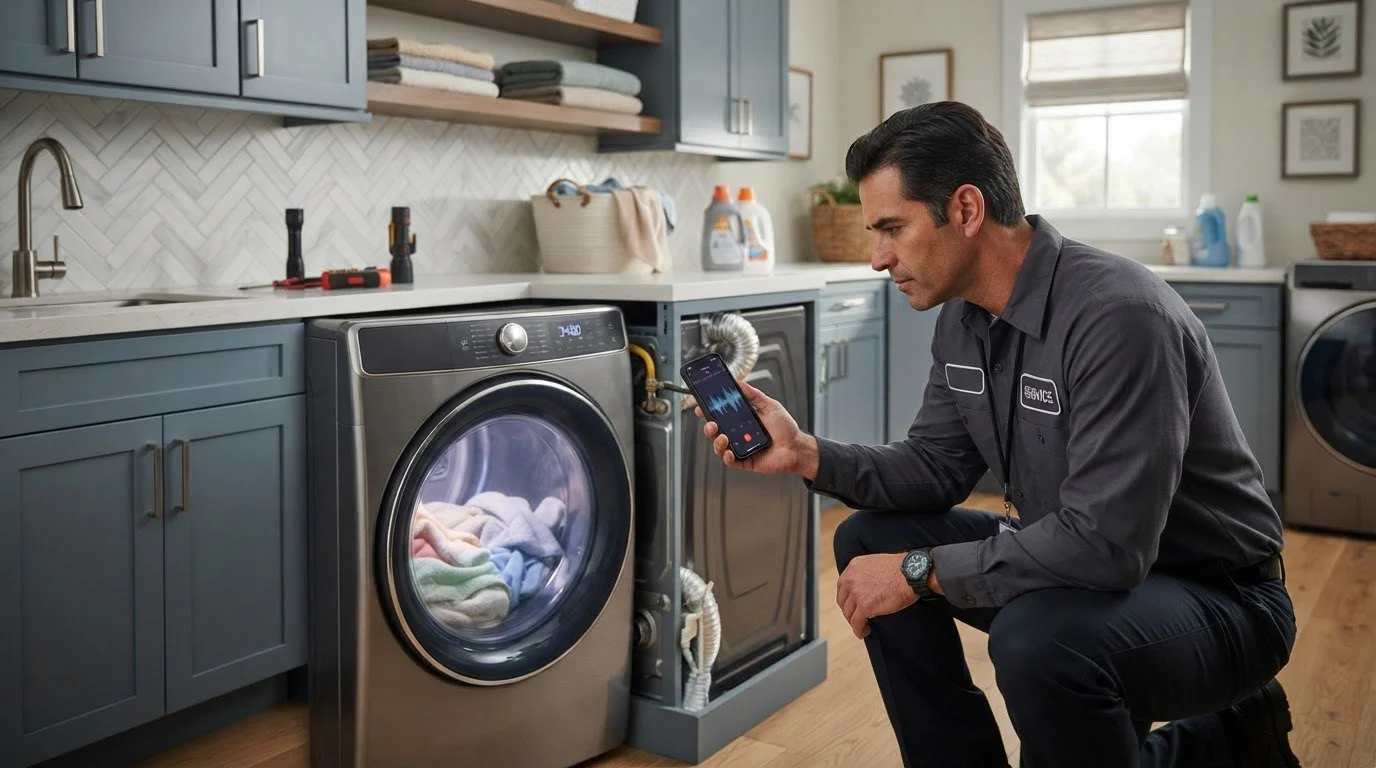
Some dryer noises come and go. A rhythmic thump is different: it repeats with every rotation, speeds up if the drum speeds up, and stops when the drum stops. That regularity is useful information. Something that rotates once per turn is touching, rubbing or hitting something it should not, and the places where that can happen are limited.
Run the dryer empty for a short moment. If the thump is still there with no clothes, you have ruled out a load problem such as a shoe, a zipper or a heavy blanket landing in the same place each turn. If it appears only with a load, try a smaller, softer mix of clothing first. Many thumps in an Electrolux dryer turn out to be a stiff item that lands on the same spot every revolution.
Next, notice what the sound resembles. A dull thud once per turn points toward the drum and its supports. A squeal or scrape points more toward a bearing or pulley. A flapping sound is often a loose edge of a seal. Having these descriptions ready helps us decide what to bring on the first visit.
Many dryer drums rest on small wheels or sliding pads that wear. When a roller develops a flat spot, the drum drops slightly with every pass of that spot, and you hear and sometimes feel a thump. This is one of the most common causes of a rhythmic noise in dryers that have run for many cycles. It often sounds worse right after the dryer has sat idle and softens as it warms up.
The front and rear edges of the drum seal against the cabinet with a felt or foam strip. If that strip curls or comes loose, it can catch once per turn. The sound is usually softer, more of a brush than a bang, but it can rise sharply when the strip folds under.
A belt that has a lump, a glazed patch or a worn spot passes over the pulley once per its own revolution, not necessarily once per drum turn, so you may hear a faster thump that lines up with the motor rather than the drum. A belt that is failing may also slip, which can make clothes tumble sluggishly.
Worn bearings and pulleys tend to add a growl or squeal before they thump. If you hear those with the thump, mention both. The related manual codes concern the drum motor: E51 for a drum motor relay error, E52 for a motor that is stopped or not starting, and E53 and E54 for centrifugal switch and sensing errors. A motor that struggles can also show a rhythmic hesitation. The page for E52 drum motor describes that reading.
Coins, buttons, a small sock or a hair clip can slip past the lint screen area and into the gap behind the drum. They tumble, hit and sometimes wedge. This is more likely if the thump began suddenly right after a specific load.
If the cabinet itself rocks, the thump can be amplified into a bang. Look at all four feet. A dryer on uneven floorboards, as in many older San Francisco flats, can rock slightly and strike the wall or a neighboring stacked washer. In a closet install, check whether the cabinet touches the doorframe or a shelf. The exhaust duct should not be pinned against the back of the dryer either; a crushed duct can both restrict airflow and make contact noise.
Stop right away if the sound turns into grinding or squealing, if the drum catches or stalls, if you smell burning rubber or hot metal, or if the dryer trips the breaker. A seized roller or a failing belt can wear into the drum, and a heated drum that does not turn properly can scorch clothing. Cut power at the breaker for burning smells or sparks. A gas model with any gas smell is a different matter: leave the home, avoid switches and call the gas utility or 911 from outside.
Drum support designs differ between the front-load pair and the top-load pair. The label is usually inside the dryer door opening or on the door frame, and the first letters tell us the layout, such as ELFE for a front-load electric dryer or ELVG for a top-load gas one. A model like the ELFE7437AW, a 400 Series electric dryer, gives us a starting point for parts, but we confirm everything at the visit.
We watch and listen to the dryer under load, then isolate the noise by checking supports, seal, belt and motor path. You receive a written estimate before anything is changed, and nothing is repaired without your approval. See our Electrolux dryer repair page for the full process.
Worn support rollers often flatten while the dryer sits idle. They can sound worse at the start of a cycle and quieter as the parts warm and settle.
Yes. A neglected worn roller or belt can wear into surrounding parts. Stopping early usually limits the repair.
No. A noise alone is mechanical. The motor codes, such as E52, appear on the display when the control detects a motor problem.
Possibly. Stiff shoes, bath mats or heavy blankets can land in one spot every turn. Running the dryer empty shows quickly whether the load is responsible.
Share the model number, whether the thump happens empty, how often it repeats, and any squeal or burning smell that accompanies it.
Share a few details and we’ll confirm an appointment. Prefer to talk? Call us and we’ll help right away.