Dryers: Electric and Gas Lineup, Venting and Common Problems
Electrolux electric and gas dryers by series, where to find the label, display codes and the venting checks that fix many complaints…

Specialized Electrolux Appliance Repair in San Francisco
Mon–Sat: 8:00 AM – 7:00 PM
Cold clothes, long cycles and noisy drums often start at the vent. We check airflow, heat and motion in that order.
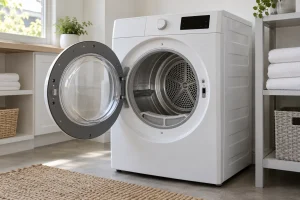
A dryer is simple on paper: a blower pulls room air past a heat source, the drum tumbles the load, and a vent carries the moist air outside. Most of what goes wrong is about one of three things, heat, airflow or motion, and the symptom usually tells you which. Electrolux dryers in San Francisco flats and Bay Area homes often share a vent run with a tight bend or a long path to an exterior wall, so airflow trouble shows up more often than owners expect.
The first suspect is the vent, not the dryer. A lint-packed duct, a crushed flexible hose behind the machine, a clogged wall cap or a lint screen coated in a fabric-softener film all choke airflow, and the dryer then takes longer or shuts off the heat to protect itself. If the vent is clear and clothes are still wet, a technician looks at the heating element or gas burner, the thermal fuses and the temperature sensors. The post on hot clothes that are still damp and the one on a dryer where auto dry ends too soon explain how moisture sensing can fool the cycle in either direction.
On an electric dryer, no heat can mean a tripped half of the two-pole breaker, an open heater, a blown thermal part or a control that is not calling for heat. On a gas dryer it can also mean the gas valve to the dryer is closed, the igniter is weak or the valve coils are not opening. The drum may tumble normally the whole time, which is why people assume the dryer is fine until the clothes come out cold.
A dryer that quits after it warms up is often protecting itself from overheating or a failing component that acts up when hot. One that will not start may have an open door switch, a worn start relay, a motor problem or a board fault. Our article on a dryer that stops when warm lists the checks in order.
A rhythmic thump once per drum turn tends to point at a flat spot or worn drum support roller; a high squeal points at a roller, idler pulley or motor bearing; scraping can be a drum seal or something stuck between drum and cabinet. Read dryer rhythmic thump before deciding it is only a sock.
We start with the vent because it changes everything else: a restricted exhaust can make a healthy heater look faulty. Then we confirm the power supply type, run the dryer, watch whether the drum turns and heat builds, read any code and test the part that matches the symptom. A recommendation comes as a written estimate. Nothing is replaced until you approve it, and if the vent turns out to be the whole problem, you hear that first.
Dryer codes usually begin with E, and some boards show a shorter version of the same code. Write down every character. Frequently seen entries include EF1 for blocked ventilation, E64 for an open heater circuit, E66 for an open thermal limiter, E52 for a drum motor start problem and E41 for the door being opened at cycle start. A code points the technician to a circuit; it does not name the failed part. Browse the error codes index for the rest.
Gas versus electric is the first fork. An electric dryer needs a dedicated high-power outlet and the correct cord; a gas dryer needs a gas supply with an accessible shut-off valve, a flexible connector and still the same exhaust path. In older San Francisco buildings the vent may run through a wall or up a light well in a way that no one has cleaned in years, and a rooftop or side-wall termination with a damaged flap lets birds, lint and wind interfere. Closet installations need a louvered door or an opening so the dryer can draw room air; a sealed closet starves the burner or heater of air and extends every cycle.
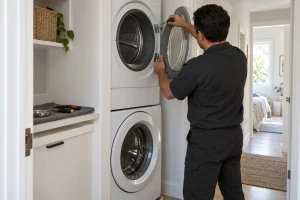
Stacked arrangements, with a dryer above or beside a washer, make the back harder to reach and often use a short transition duct that kinks when the pair is pushed back. Models that pair with front-load washers, like the ELFE and ELFG lines, and those that pair with top-loaders, like the ELVE and ELVG lines, are built differently inside, so the label matters when parts are ordered. Laundry towers combine both appliances in one frame and are covered at Electrolux laundry tower repair.
Do not open the cabinet, probe the heater or pry at the burner. If you smell gas, leave the home without touching switches and call the gas utility or 911 from outside.
Stop and switch off the breaker if you smell burning, see scorched lint, notice the cabinet becoming too hot to touch, or the dryer keeps tripping the breaker. Lint is fuel, and a dryer running on a blocked vent is a fire risk, so a slow, hot, smelly dryer deserves attention before another load.
The label is usually inside the dryer door opening. Electric and gas versions share cabinets but not parts, and a series name changes the controls. For example, the ELFG7437AW is a gas model in the 400 Series, while the ELFE7637AT is electric in the 600 Series that lists LuxCare Dry. The ELVE7400AW is an electric model that pairs with a top-load washer. Tell us the full label, including the fuel letter.
Send the dryer type, the symptom and the label. We confirm your address is in our San Francisco and Bay Area range, agree on a window and arrive to inspect the dryer where it stands. Please leave room to pull it forward and know where your gas valve or breaker is.
The lineup and label locations are covered on Electrolux dryers. A paired washer is covered under Electrolux washer repair.
The heat source is not firing or is being cut off. That can be a tripped half of the breaker, a failed heating part, a gas supply issue or a safety device reacting to poor airflow. Check the breaker and vent, then book a diagnosis.
Often enough that the run never feels weak at the outside cap. If loads take longer than they used to, clean the duct first, especially where it is long or has bends.
No. Leave the home, avoid switches and call the gas utility or 911 from outside before anyone touches the dryer again.
A light squeak is a warning, but grinding, burning smells or a drum that catches are reasons to stop and have it checked before the damage spreads to the motor or drum.
Yes, both, including units in closets and stacked setups across San Francisco and the Bay Area.
Electrolux electric and gas dryers by series, where to find the label, display codes and the venting checks that fix many complaints…
Electrolux induction and gas cooktop repair in San Francisco and the Bay Area, from rejected pans and dead zones to igniters and…
Electrolux dishwashers that leave dishes dirty, hold water or show a code, diagnosed under tight Bay Area cabinets with a written estimate…
Soft food, heavy frost, a pooling drain or a loud fan: Electrolux freezers diagnosed and repaired across San Francisco and the Bay…
No ice, thin cubes, a jammed chute or water on the floor: Electrolux ice makers traced from supply to mold across San…
Stacked Electrolux washer-dryer towers, electric or gas, repaired in closets and hallways around San Francisco and the Bay Area, one half at…
Repair for Electrolux built-in drawer and side-swing microwaves in San Francisco and the Bay Area, covering no heat, door latches and display…
Diagnosis for Electrolux dual-fuel and induction ranges in San Francisco and the Bay Area, from burners and zones to oven heat and…
Warm compartments, leaks, noises, dispenser trouble or a flashing code: diagnosis and repair of Electrolux refrigerators across San Francisco and the Bay…
Repair for Electrolux single and microwave-combination wall ovens in San Francisco and the Bay Area, covering heat, fans, door latches and displays.
Front-load and top-load Electrolux washers that will not fill, drain, spin or unlock, diagnosed in San Francisco and the Bay Area with…
Temperature swings, a cooler that stays warm, fogged glass or noisy fans: Electrolux wine and beverage coolers serviced across San Francisco and…
Share a few details and we’ll confirm an appointment. Prefer to talk? Call us and we’ll help right away.