

Specialized Electrolux Appliance Repair in San Francisco
Mon–Sat: 8:00 AM – 7:00 PM
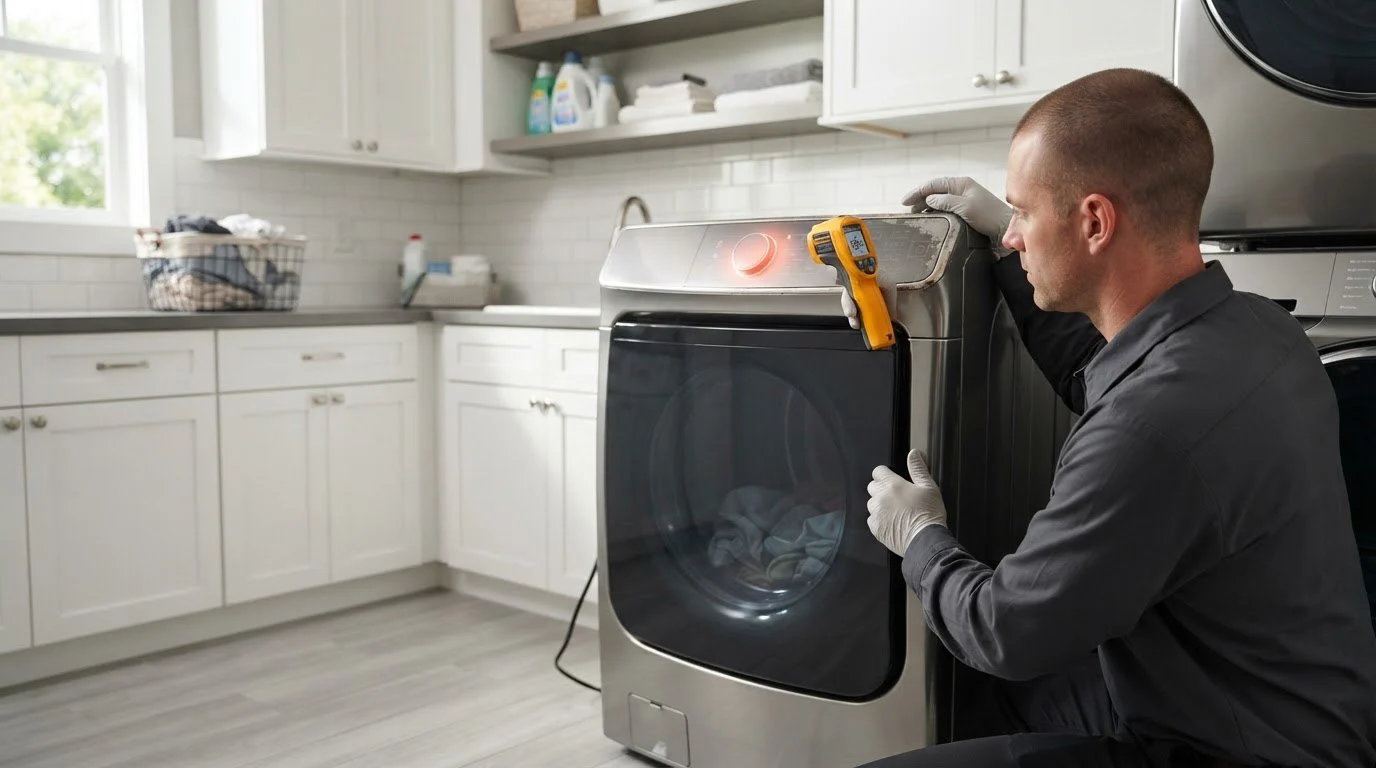
The dryer runs fine at first, then quits once things warm up and refuses to continue. Safety limits, airflow and motor behavior are the main suspects, and some checks are easy.
The drum turns, heat builds, the laundry gets warm, and then the dryer simply stops. Sometimes it restarts after a rest and runs again for a similar stretch. Sometimes the display goes blank or shows a code. The timing is the key clue: the problem appears only after the dryer has been running long enough to heat up. That points toward things that react to temperature or load over time, not toward a part that is dead from the start.
An Electrolux dryer has temperature limits on the heated air path. If the air gets too hot, a thermostat opens or the control interrupts the heater, and in some conditions the whole cycle ends. The manual lists E65 for a thermostat that is open or a high-limit thermostat tripping too often, and E66 for an open thermal limiter at the outlet. Related heater readings include E61 for a heater relay error, E63 for a heater short and E64 for an open heater circuit.
Those limits protect the dryer from overheating. They usually trip because something is wrong with airflow, not because the limit part itself failed. The first look therefore goes to the vent, not to the thermostat. Read more about the thermal reading on the E65 thermostat page.
A packed lint screen, a lint-clogged housing, a crushed duct, or a blocked outdoor flap holds heat inside the drum. The temperature rises faster than it should, the limit trips, the dryer pauses, cools, and may run again. If the dryer has been slowly taking longer to dry clothes, this is the likeliest cause. The manual’s EF1 reading, ventilation blocked, fits here, as does EF3, a maximum timeout where the exhaust is blocked or the sensor or board has a fault.
If the drum motor or its control is weak, it may run until it warms and then drop out. Often the drum slows or hesitates first. The motor codes E51 through E54 describe relay, start, centrifugal switch and sensing errors on the drum motor. A dryer that stops with a clicking or humming sound, then cannot start for a while, belongs in this group.
A tight support roller, a belt in trouble or a stuck item adds drag. The motor works harder, heats up and then quits. The rhythmic noise described in our post on a dryer rhythmic thump often precedes this.
Electric dryers need correct line voltage on both legs. The manual includes EA2 for line voltage that is too high, EA3 for too low, and EA4 for improper home wiring. A partly failing breaker, a loose terminal or a worn outlet can heat up under load and cut out. A display that dies or a breaker that feels warm to the touch are warning signs. The power-related codes EH1 to EH4 cover frequency, amplitude and wiring errors. Contact an electrician if the breaker or outlet seems damaged.
Write down how long it runs before it stops, whether the drum is hot to the touch, whether the display shows a code or goes blank, whether the dryer restarts after a rest, and whether the load size or type matters. Those details separate airflow problems from electrical ones. A dryer that stops at the same point regardless of load is acting differently from one that quits only with heavy items.
Do not bypass any thermostat or switch to keep the dryer running, and do not reach into the control area. Do not keep restarting a dryer that stops repeatedly; each restart sends more heat into whatever is restricted. Do not leave the dryer running while you are out, especially if it has been stopping on its own. If you smell scorching or see sparks, turn the breaker off and stay clear. With a gas model, any gas smell means leaving the home, avoiding switches and calling the gas utility or 911 from outside.
A gas dryer adds a burner, igniter and flame sensing. If the burner shuts off early because exhaust cannot clear, the dryer may keep tumbling but stop heating, which looks different from a dead stop. An electric dryer relies on a heating element and its relays. Because the heat source differs, the model letters matter: a model beginning ELVG or ELFG is gas, while ELVE and ELFE are electric. For example, the ELVE7700AB is an electric top-load pair dryer, and its gas counterpart carries the ELVG prefix.
Book when the lint screen and duct are clear and the dryer still stops, when a heater, thermostat, motor or voltage code appears, or when the breaker or outlet seems warm. We diagnose before repairing, give a written estimate, and do nothing without your approval. Our Electrolux dryer repair page lays out the visit.
A temperature limit may have opened and then reset as the parts cooled. That points to heat or airflow, and the cause should be found before it trips again.
Yes, but it is less common than a vent restriction. Testing the airflow first prevents replacing a part that was doing its job.
It is better to wait. Repeated stopping means something is overheating or struggling, and continued use can add damage.
Not always. A tripped breaker, a loose supply connection or a safety interruption can also leave the display dark.
Share the model number, how long the dryer runs before stopping, any code shown, and whether the breaker or outlet feels warm.
Share a few details and we’ll confirm an appointment. Prefer to talk? Call us and we’ll help right away.