

Specialized Electrolux Appliance Repair in San Francisco
Mon–Sat: 8:00 AM – 7:00 PM
Water takes forever on one zone while the others boil fine. Learn how to separate cookware and power limits from a zone problem, and which readings point to a technician.
Everyone who cooks on induction knows the speed of a healthy zone. When one zone seems sluggish, pots take longer to come up to heat, or the power appears to fade partway through, it stands out right away. The zone does not display an error, and the pan is the same one that worked last week. Yet something has changed, and the explanation may lie in how induction manages power as much as in any damaged part.
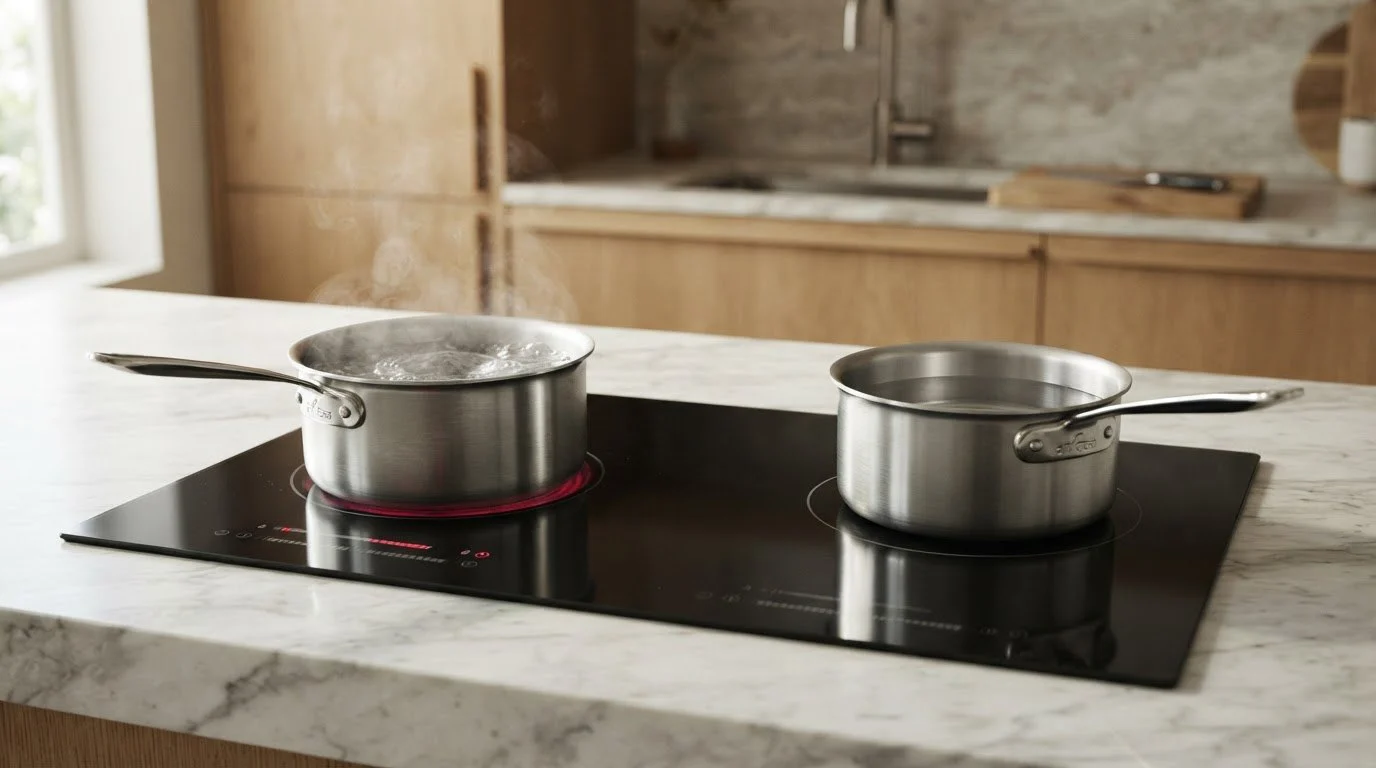
An Electrolux induction cooktop draws power from one supply and divides it among the zones in use. When several zones run on high at once, the cooktop may lower the output of some to stay within its limit. Zones that share an induction generator, usually on the same side, are especially linked. So a weak zone can simply be the one being throttled because its neighbor is working hard. Try running the weak zone alone, with the others off, and compare.
The cooktop may also reduce output as the pan, the glass or the electronics warm up. This is normal protective behavior. It becomes a concern only when it happens very early or without any obvious reason.
Thin, warped or partly magnetic pans heat unevenly. A pan whose base is smaller than the zone ring, or one that has a bowed bottom, makes poor contact with the glass and delivers less heat. Check that the pan sits flat and centered, and compare it with a heavy, flat-bottomed pan on the same zone. If a good pan boils quickly there, the issue was cookware.
Try the same pan on another zone of similar size. If it performs well elsewhere and poorly on the suspect zone with other pans too, the zone becomes the focus.
Each zone has temperature monitoring. If a sensor reads too hot, the cooktop reduces power or cuts out. If it fails, the zone may behave oddly. The manual lists codes 51, 52, 54 and 55 for sensor breaks at the left front, left rear, right rear and right front, and 61, 62, 64 and 65 for the same positions reading too hot. A reading such as code 61, left front too hot, often appears after a pan has been left empty or a vent path has been blocked.
Cooling is just as important. Induction electronics sit beneath the glass and depend on airflow. If a deep drawer, stored pans or a trash bin crowds the space below the cooktop, heat accumulates and the cooktop cuts back. A weak zone that gets worse after long use fits this picture.
The cooktop also watches the incoming voltage. The manual describes codes 30 and 70 as AC input voltage too high and 35 and 75 as too low at the induction housing. A loose breaker connection, a failing breaker, or a supply that sags under load can lead to reduced output without the cooktop being at fault. If other large appliances on the same circuit run at the same time, mention it when you call. In older buildings, such as many San Francisco flats and rentals, the kitchen circuit may be shared in ways that are not obvious.
When a zone is genuinely weak, one cause is the generator that drives it. The manual describes left-side errors in the 31 to 37 range, right-side errors in the 71 to 77 range, and a LIN bus communication error as 21. These readings indicate where a technician should begin, not that a particular part must be replaced. A weak zone that comes and goes, with a short beep or flashing indicator, is a good reason to record the code and not clear it away.
Do not run an empty pan to test a zone; the pan and cooktop can both overheat. Do not cover the cooktop or its vents with foil to boost heat. Do not open the cabinet to reach under the glass. If you see a crack, smell something burning, or find the glass hot with no pan on it, turn off the breaker and stop using the cooktop.
The number of zones, the layout and the power sharing differ between sizes. The label is usually on the underside or frame of the cooktop. The ECCI3068AS is a 30-inch unit and the ECCI3668AS is a 36-inch one, both electric induction, so we use the exact number to find the right diagram.
Book if the zone stays weak with good cookware and solo use, if a code returns, or if the weakness spreads to other zones. We diagnose before repairing, provide a written estimate, and do not repair without your approval. Details are on the Electrolux cooktop repair page.
It may share power with a busy neighbor, the pan may be a poor match, or the zone may be limiting itself for temperature reasons. Solo testing helps tell them apart.
It can. The electronics need airflow, and crowding the space below can make the cooktop reduce output to protect itself.
Not by itself. It indicates where a technician should look first, and testing confirms the actual cause.
Yes. A weak connection or a sagging supply can lower the output of the whole cooktop, especially under heavy use.
Record the model number, which zone is weak, whether neighbors were running, the cookware you tried and any code.
Share a few details and we’ll confirm an appointment. Prefer to talk? Call us and we’ll help right away.