

Specialized Electrolux Appliance Repair in San Francisco
Mon–Sat: 8:00 AM – 7:00 PM
The cycle finishes, the dishes feel gritty, and the pod is still sitting in its compartment. The cause is often the lid, the spray path or the water, rather than the pod itself.
You open the door at the end of the cycle and the compartment still holds a half-melted pod. The dishes carry a gritty film, and the glasses look dull. It is a messy, wasteful result, and it is tempting to blame the pod brand. In practice the dispenser works only if three things happen in the right order: the lid releases, water sprays onto the detergent, and the cycle runs long enough to dissolve it. A failure at any step leaves the pod behind.
In an Electrolux dishwasher, the detergent cup sits on the inner door. At the right point in the cycle, a small mechanism releases the lid, and water thrown from the spray arms and the wash action reaches the compartment. The detergent dissolves into the wash water and is circulated. If the lid stays closed, the pod sits shut inside; if the lid opens but nothing sprays the cup, the pod can sit there dry or only partly wet.
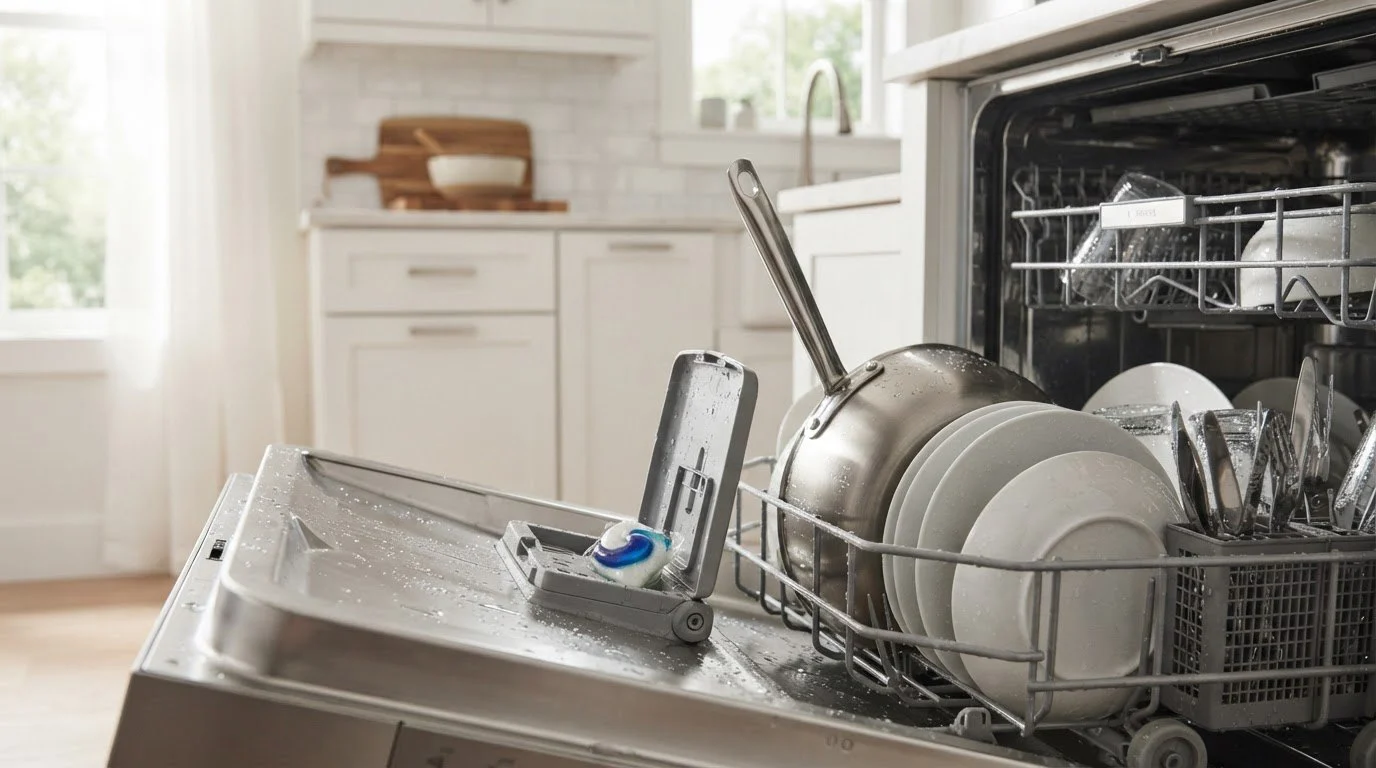
The most frequent cause is physical obstruction. A tall platter, a baking sheet or a large pot standing on the upper rack can block the lid’s travel. Dishes in the lower rack that lean toward the door can also press the lid shut. Run your hand along the path of the lid and look at what sits near it. If something touches the door or the cup, reload with that item moved.
The lid latch itself can also get sticky. Old detergent residue builds up around the catch and the hinge until the lid opens only partway or not at all. Wiping the area with a warm damp cloth and checking that the lid snaps shut and opens freely helps. If it feels stiff or sluggish when you press the release by hand, the mechanism may be worn.
If the lid opens but the pod stays whole, check the spray. A spray arm that is clogged or not turning leaves the door area dry. Spin each arm by hand and see whether it moves freely. Look at the small holes for bits of food, seeds or labels. Remove loose debris you can see, and rinse the arm if it detaches by hand as the manual describes.
A low or slow water supply has the same effect. The manual lists i10 for a water supply problem where there is not enough water or the incoming supply is not detected, and the page for i10 water supply covers it. Closed or partly closed water valves, a kinked supply line under the sink, or a shared supply in an older building that dips in pressure can all be behind it.
The manual describes i40 as a clogged filter or sump with food soil built up. A blocked filter reduces circulation, so the wash water barely moves. The result looks like a failed dispenser, but it is a flow problem. Take out the filter, rinse it, and check the sump area for glass pieces or labels, as the owner guide shows.
If the display shows Hd, the manual says the dishwasher is heating the water before washing. That is not an error. It means the detergent has not yet been released and the machine is waiting. If you open the door and look at that time, the pod will naturally still be in the cup. Another cycle choice that can mislead is a short or quick wash. Pods are designed to dissolve over a normal wash; a very short program may not give them enough time, so try a standard cycle for a test.
A pod placed with wet hands can start to stick to the cup. A pod placed loose in the tub rather than in the cup may fall to the bottom and never be fully exposed, or it may dissolve too early during a pre-rinse. Place it dry in the cup, close the lid until it clicks, and run the cycle. Some pods are meant to be used in a dispenser, others in the tub; the package tells you which.
If the dishes are not just gritty but wet and cold, or the cycle ended abruptly, check for a code. Other relevant readings include CL for a door that is open or not latched, Er03 for a wash pump that is not running, and i50 for a wash motor or circulation system problem. A dishwasher that runs but moves little water, or sounds wrong, needs a technician rather than more pods.
Do not use dish soap in the dispenser. It creates heavy suds and can overflow or leak. Do not pry at the dispenser mechanism or open the inner door panel. Do not keep adding extra pods to compensate, because undissolved detergent builds up. If you find water on the floor, switch off the dishwasher at its breaker and turn off the supply valve.
Dispenser design, spray arm layout and circulation differ among lines. The label is usually on the door frame or the side edge of the inner door. For instance, the EDSH4944BS is a 24-inch Electrolux dishwasher, and the ICON E24ID75SPS is also 24 inches wide. The exact number tells us which parts apply.
Book if the lid is clear, the arms spin, the filter is clean and the pod is still left behind, or if a code shows. We diagnose before repairing, give a written estimate, and repair only with your approval. Read more on our Electrolux dishwasher repair page.
The lid may have been blocked, water may not have reached the cup, or the cycle may have been too short. Reloading and checking the spray arms usually answers it.
Sometimes, but changing brands rarely fixes a blocked lid or a weak spray. Check the mechanical causes first.
No. The manual lists Hd as a heat delay, where the unit heats water before washing. The pod is expected to remain until the wash begins.
Indirectly, yes. Poor circulation means little water reaches the cup, so detergent stays undissolved.
Give the model number, the pod type, how you load the upper rack, and any code that appears.
Share a few details and we’ll confirm an appointment. Prefer to talk? Call us and we’ll help right away.