Dishwashers
Electrolux dishwashers come in 24-inch and 18-inch widths, including the ICON line. See the lineup, where the label sits and what to…

Specialized Electrolux Appliance Repair in San Francisco
Mon–Sat: 8:00 AM – 7:00 PM
Standing water, cloudy glasses or a blinking code: we check the filter, drain path and pump before suggesting a part.
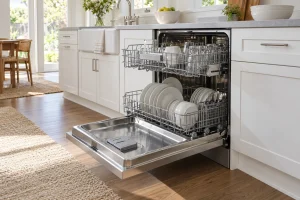
A dishwasher does five jobs in a row: fills with the right amount of water, mixes in detergent, circulates it through the spray arms, drains, and dries. When dishes come out dirty, wet or smelling, the fault can sit at any of those steps, and the visible result seldom says which. Electrolux dishwashers in San Francisco kitchens are mostly 24-inch built-ins under tight cabinetry, with an 18-inch model also in the range, so access and plumbing details shape the repair.
Poor cleaning can mean a clogged filter, a blocked spray arm, low water at the start, weak circulation or a dispenser that did not open. Cloudy glassware is often a chemistry and rinse issue rather than a fault, which is covered in cloudy glasses from the dishwasher. A tablet that does not dissolve is a flow and door-opening problem, discussed in pod left in the dispenser.
Standing water after a cycle points to the drain path: the filter and sump, the drain hose with its high loop, a pump that is not moving water, a drain valve problem, or the disposal knockout plug that was never removed. Some water below the filter is normal, and water below the filter helps you tell the difference.
A dishwasher that does nothing may be waiting on the door latch, a control or the water supply. If the display shows a door or lock code, check that nothing blocks the rack or the door seal before assuming a board failure.
Leak detection on these machines can shut a cycle down. The water may come from the door seal, a loose hose clamp, the pump housing, the water inlet or the sump. Because the cabinetry hides most of the connections, we follow the water to its source rather than guessing.
Some Electrolux models rely on a vent damper and fans during drying, and a fan or damper fault leaves moisture behind. Plastic items also dry poorly on any machine, so we separate the normal from the faulty.
We ask what the cycle did, whether the problem is every load or only some, and whether a disposal, new dishwasher hose or detergent changed. At the machine we check the filter and sump, run a cycle, watch the fill, listen for the pump, read any code and test the part that matches. You then get a written estimate. We do not replace anything until you approve it.
Electrolux dishwashers use codes like i10 and Er01, and some are shown with alternate spellings. Write down the code exactly. Typical entries include CL for a door that is open or not latched, i10 for a water supply problem, i20 for incomplete draining, i30 for the anti-flood leak protection, i40 for a clogged filter or sump, and Er03 for a wash pump that is not running. The error codes index has the full set. A code narrows the search; it does not confirm a failed part.
Built-in dishwashers hide their plumbing behind a toe kick and under the countertop, and several installation choices cause problems that look like machine faults.
Narrow 18-inch units fit small apartments but have smaller racks and less room around the sump, so overloading shows sooner.
The wash pump and circulation path matter more than owners expect. If the tub fills, the spray arms spin weakly and the sound is a dull hum, the pump or a blockage in front of it may be involved. If the pump is silent, the problem could be power to the pump, the control, or the pump motor itself. A technician separates those by listening, testing and reading the code rather than swapping parts, and we apply the same patience to a heating complaint where dishes come out cool or greasy, since a heater, a sensor and a control all play a part.
Do not remove the lower access panel to reach wiring, and do not run a machine that is leaking onto the floor.
Turn off the breaker and close the stop valve if you see water on the floor, smell burning, notice smoke from the base or hear loud grinding. Water that gets under flooring can cause damage far from the sink, which is especially serious in condos and rentals.
The label is usually on the inside edge or side of the door frame. Some entries are base families, so the last letters vary by finish or version, as with the EDSR1832 family, an 18-inch dishwasher. The EDSH4944BS is a 24-inch model that is currently sold, while the E24ID75SPS belongs to the ICON line. Give us the complete label so the right drain, pump or control parts are quoted.
Tell us the symptom and the label. We confirm your address in San Francisco or the Bay Area, agree on a window and arrive to look at the dishwasher in place. Please empty the tub and clear the area under the sink.
See the lineup and where labels sit on Electrolux dishwashers. If a stacked washer and dryer share the kitchen alcove, the Electrolux washer repair page covers water-line and drain questions for that appliance as well.
A small amount near the sump can be normal. A pool above the filter means the drain path needs checking.
No. Codes name a circuit or condition, such as a pump or sensor, and the part behind it still needs testing.
You can clean the filter and clear the sink. Anything behind the lower panel is for a technician.
Yes, along with 24-inch Electrolux dishwashers across San Francisco and the Bay Area.
The model label, any code, and a short note about when the problem began.
Electrolux dishwashers come in 24-inch and 18-inch widths, including the ICON line. See the lineup, where the label sits and what to…
Electrolux induction and gas cooktop repair in San Francisco and the Bay Area, from rejected pans and dead zones to igniters and…
Electric and gas Electrolux dryers with no heat, long cycles, odd noises or early stops, checked from the vent to the drum…
Soft food, heavy frost, a pooling drain or a loud fan: Electrolux freezers diagnosed and repaired across San Francisco and the Bay…
No ice, thin cubes, a jammed chute or water on the floor: Electrolux ice makers traced from supply to mold across San…
Stacked Electrolux washer-dryer towers, electric or gas, repaired in closets and hallways around San Francisco and the Bay Area, one half at…
Repair for Electrolux built-in drawer and side-swing microwaves in San Francisco and the Bay Area, covering no heat, door latches and display…
Diagnosis for Electrolux dual-fuel and induction ranges in San Francisco and the Bay Area, from burners and zones to oven heat and…
Warm compartments, leaks, noises, dispenser trouble or a flashing code: diagnosis and repair of Electrolux refrigerators across San Francisco and the Bay…
Repair for Electrolux single and microwave-combination wall ovens in San Francisco and the Bay Area, covering heat, fans, door latches and displays.
Front-load and top-load Electrolux washers that will not fill, drain, spin or unlock, diagnosed in San Francisco and the Bay Area with…
Temperature swings, a cooler that stays warm, fogged glass or noisy fans: Electrolux wine and beverage coolers serviced across San Francisco and…
Share a few details and we’ll confirm an appointment. Prefer to talk? Call us and we’ll help right away.