Ice Maker Repair in San Francisco
No ice, thin cubes, a jammed chute or water on the floor: Electrolux ice makers traced from supply to mold across San…

Specialized Electrolux Appliance Repair in San Francisco
Mon–Sat: 8:00 AM – 7:00 PM
Whether the ice maker is inside a French-door refrigerator or built into a bar, the same few things usually go wrong.
An ice maker is a small system with several dependent parts: a water supply, a valve, a mold or tray, a heater or sensor that releases the ice, a bin and sometimes a dispenser chute. When one step stops, the whole chain looks dead from the outside.
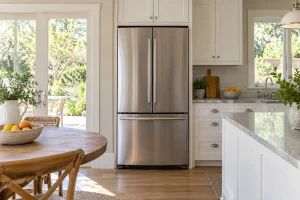
Most are part of a refrigerator, usually in the freezer compartment of a French-door model, and feed an ice bin and a door dispenser. Our refrigerator guide lists those models. Freestanding or under-counter ice makers are a separate product type. The site does not list specific model numbers for them, so the general guidance below applies, and the full label is the starting point for any visit.
On a refrigerator, the label is usually on the inside wall of the fresh-food compartment. On an under-counter unit it is typically behind the bin or on the cabinet frame. If the bin is full of ice, take it out first so the label is visible.
Start upstream. Is the water supply valve open, is the line pinched behind the appliance, and is the filter due? A filter that has clogged cuts the flow to a trickle. Further in, the inlet valve may not open or the mold may not heat to release the ice.
Low water pressure and a clogged filter give small or hollow cubes. Cubes that fuse into a block usually mean melting and refreezing in the bin, which relates to temperature or to infrequent use.
That points to the dispenser path: a jam in the chute, a door flap that does not open, or a stuck auger. The display may show DI SP for an ice jam in the dispenser chute.
Water under the unit may come from a loose fitting at the supply, an ice maker fill tube freezing and overflowing, or the filter housing.
Old ice absorbs odors from the freezer. Our article on water taste after a filter change covers the air in the filter housing and the first glasses afterward.
Ice makers depend on a clean cold supply. In flats and condos the supply line may be a long run from a valve behind a cabinet, and in older buildings the valve is sometimes partly closed after past plumbing work. Kinked copper or plastic tubing behind a refrigerator pushed back tightly is a frequent culprit, so slide the appliance out only when you can do so gently, and do not strain the line.
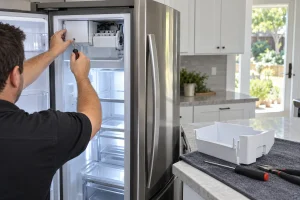
The sequence is simple to describe. Water enters through the inlet valve and fills the mold; a sensor decides when the ice is ready; a small heater or motor releases it; an arm or optical sensor decides whether the bin needs more. We check each hand-off in that order, so a replacement part is named only after we have seen where the sequence stops. With a dispenser, we also inspect the chute, flap, auger and door switch, because they cause a share of complaints that look like an ice maker failure.
Do not pour hot water into the mold or use tools to break up ice near the heater and wiring.
Details of how we work are on the Electrolux ice maker repair page. You get a diagnosis, a written estimate and no work without your approval. Use contact to ask for a visit.
Ice making depends on a sequence of timing and sensors, not only temperature. A stuck arm, a bin that is not seated or a blocked fill tube can stop the cycle.
Allow a full day. The first batches often get discarded and the machine needs several cycles to refill.
The sound of a harvest is normal. Grinding that continues points to ice jammed against moving parts.
Yes. A clogged filter lowers water flow and may leave small or hollow cubes.
Better to turn the ice maker off and close the supply valve until a technician looks at it, since leaks can reach the floor.
No ice, thin cubes, a jammed chute or water on the floor: Electrolux ice makers traced from supply to mold across San…
Electrolux cooktops include induction models in 30 and 36 inches and a 36-inch gas model. See the lineup, common complaints, codes and…
Electrolux dishwashers come in 24-inch and 18-inch widths, including the ICON line. See the lineup, where the label sits and what to…
Electrolux electric and gas dryers by series, where to find the label, display codes and the venting checks that fix many complaints…
What to know about Electrolux built-in freezers in San Francisco homes: reading the label, the frost and warm-up complaints we see, and…
A laundry tower puts a washer and a dryer in one stacked cabinet. Here is how the Electrolux tower lineup is organized…
Electrolux built-in microwaves open either as a drop-down drawer door or a side swing. Check the lineup, label spot and safe first…
Electrolux ranges combine an oven and a cooktop in one 30- or 36-inch body, as induction or dual fuel. See the lineup,…
French-door, column and drawer refrigeration from Electrolux, with notes on model labels, display codes and what to check before booking a visit…
Electrolux 30-inch electric wall ovens come as a single oven or a microwave combination stacked in one cabinet. Learn the models, label…
Electrolux front-load and top-load washers by series, where the label is, the display codes and safe checks before you book a repair.
A guide to Electrolux under-counter wine and beverage coolers: where the label sits, why temperature drifts, what you can check and when…
Share a few details and we’ll confirm an appointment. Prefer to talk? Call us and we’ll help right away.