Wine and Beverage Coolers: Guide for Owners
A guide to Electrolux under-counter wine and beverage coolers: where the label sits, why temperature drifts, what you can check and when…

Specialized Electrolux Appliance Repair in San Francisco
Mon–Sat: 8:00 AM – 7:00 PM
Under-counter and built-in coolers, checked for airflow, sealing and sensing before any part is replaced.
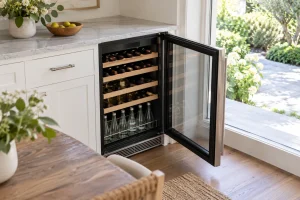
A wine or beverage cooler asks for steadiness more than raw cold. Bottles sitting for weeks need a temperature that does not wander, and a cooler that runs hot at four in the afternoon and cold at midnight is failing at its main job even if the display looks fine. Many of these coolers sit under a counter, beside a bar or inside a run of kitchen cabinets in San Francisco flats and Bay Area homes, where heat and tight spaces make life harder for them. We diagnose Electrolux wine and beverage coolers before replacing anything, and tell you what we find in plain terms.
Swings are the most frequent reason for a call. A cooler that cools well, shuts off and then drifts up quickly may have a weak door seal, a fan that is not moving air evenly, or a sensor that misreports the cabinet temperature. Where the sensor sits and how air moves past it decide how stable the cooler is, which is why a technician checks airflow and sensing together. For one detailed case, read Electrolux wine cooler temperature swings.
If the cooler is simply warm, the questions become more basic. Is it receiving power? Is the display on? Is the fan inside turning? Is the condenser area packed with dust, or is the unit squeezed so tightly into its opening that heat has nowhere to go? A cooler that hums but stays warm differs from one that is silent, and each leads to a different part of the diagnosis.
A glass door and a damp room make condensation likely. Beyond that, a blocked drain path, a tilted cabinet or a crooked door can send water onto the shelves or the floor. We look at whether the moisture comes from the room, the door seal or the cooler itself.
A fan touching a shelf liner, a bottle rattling in its rack, or a unit that vibrates against the cabinet walls can sound like a failure when it is only a fit problem. A compressor that clicks and cannot start is a more serious sign, and we separate the two by listening and inspecting.
A dead display or an unresponsive keypad can come from the controller, the connection to the main board or a loose plug at the wall. If the display flashes a message, write it down exactly as it appears; we only interpret codes we can confirm for your model.
We begin with how the cooler is used. How full is it, how often is the door opened, where in the home does it sit, and when does the problem occur? A cooler packed tightly against its back wall blocks the air it needs to circulate, while one loaded with warm bottles will take a while to recover. Next we look at the installation: ventilation clearance, grille, leveling, door alignment and gasket condition. Then we check the cooling and sensing side. Only when a part is clearly at fault do we recommend replacing it.
You receive a written estimate before any work starts, and nothing is repaired without your approval.
Under-counter and column coolers depend on a clear path for air. Some are designed to breathe through a front grille, others need space around the sides or back, and the cabinetry around them can interfere with either. A trim kit installed too tightly, a cabinet panel pushed against the grille, or a deep shelf above the unit that traps rising heat can all cause cooling problems that no part replacement would solve.
Kitchen and bar placement matters too. A cooler beside a range, a dishwasher or a south-facing window runs hotter than one in a cool corner. In older San Francisco buildings, an alcove with no ventilation behind it can turn a fine appliance into a struggling one. We note these conditions and tell you if a change in the setting would help.
The door and its glass matter as well. A beverage cooler with a frequently used door loses cold at each opening, and a gasket that has stiffened or been pinched by a bottle label will not seal as it should.
Please do not open the rear panel, test live wiring or work on the sealed lines. Those are jobs for a technician.
Switch off the breaker if you smell burning, hear a crackle or see scorch marks near the outlet. If the cooler has stopped cooling and you have valuable bottles, move them to a cool, dark place. If the cooler beeps after an outage, appliance beeps after a power outage explains what is normal.
Wine and beverage coolers differ in width, door type and layout, and the parts that fit one will not necessarily fit another. The label is usually inside the cabinet wall or near the door frame, and it helps to photograph it before you book. A model we see is the 24-inch EI24WC15VS wine cooler. For the wider range, see Electrolux wine and beverage coolers.
If your cold storage is a full-size refrigerator, Electrolux refrigerator repair is the page to use, and for a separate freezer, see Electrolux freezer repair.
The technician asks about the symptom and its timing, inspects the cooler and the cabinet around it, and explains what is happening. If the fix is a seal, a shim or a cleaned grille, you hear that first. If a part is needed, you receive a written estimate and decide before anything proceeds.
Heat in the room is the usual factor. A cooler built into cabinetry near an oven, a sunny window or a dishwasher has to shed heat into a space that is already warm, and a blocked grille makes it worse. If it still swings with a clear grille and a cool room, a fan, sensor or control problem is more likely.
A short swing is unlikely to matter, but repeated swings or a long warm spell are hard on wine, especially bottles meant for aging. If you are worried about a valuable collection, move it to a stable spot while the cooler is checked.
Usually yes. We pull the unit forward when the cabinetry allows, or work from the front. Tell us when you book how it is trimmed in, and whether it sits under a counter or in a tall run of cabinets.
Condensation on the glass can come from a door that is not sealing, a damp room or a door opened often. It becomes a service question when it is constant, when water drips onto the shelves or when the gasket looks damaged.
Yes. Both rely on the same sort of cooling system, fans and sensors, and we look at them the same way. The model label tells us which parts apply.
A guide to Electrolux under-counter wine and beverage coolers: where the label sits, why temperature drifts, what you can check and when…
Electrolux induction and gas cooktop repair in San Francisco and the Bay Area, from rejected pans and dead zones to igniters and…
Electrolux dishwashers that leave dishes dirty, hold water or show a code, diagnosed under tight Bay Area cabinets with a written estimate…
Electric and gas Electrolux dryers with no heat, long cycles, odd noises or early stops, checked from the vent to the drum…
Soft food, heavy frost, a pooling drain or a loud fan: Electrolux freezers diagnosed and repaired across San Francisco and the Bay…
No ice, thin cubes, a jammed chute or water on the floor: Electrolux ice makers traced from supply to mold across San…
Stacked Electrolux washer-dryer towers, electric or gas, repaired in closets and hallways around San Francisco and the Bay Area, one half at…
Repair for Electrolux built-in drawer and side-swing microwaves in San Francisco and the Bay Area, covering no heat, door latches and display…
Diagnosis for Electrolux dual-fuel and induction ranges in San Francisco and the Bay Area, from burners and zones to oven heat and…
Warm compartments, leaks, noises, dispenser trouble or a flashing code: diagnosis and repair of Electrolux refrigerators across San Francisco and the Bay…
Repair for Electrolux single and microwave-combination wall ovens in San Francisco and the Bay Area, covering heat, fans, door latches and displays.
Front-load and top-load Electrolux washers that will not fill, drain, spin or unlock, diagnosed in San Francisco and the Bay Area with…
Share a few details and we’ll confirm an appointment. Prefer to talk? Call us and we’ll help right away.