Freezers: Built-In Models, Frost Problems and Checks
What to know about Electrolux built-in freezers in San Francisco homes: reading the label, the frost and warm-up complaints we see, and…

Specialized Electrolux Appliance Repair in San Francisco
Mon–Sat: 8:00 AM – 7:00 PM
Upright, built-in and refrigerator freezer sections, checked for airflow, defrost and sealing before any part is replaced.
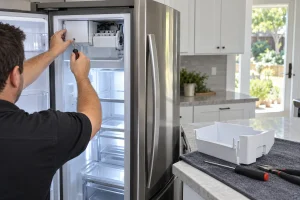
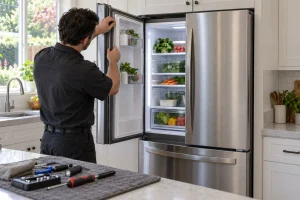
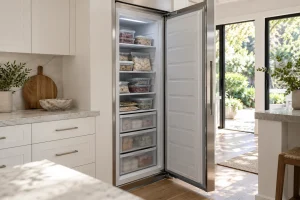
A freezer works in the background for years and nobody thinks about it until the day the ice cream turns soft or a shelf of frozen meals starts to smell strange. Whether yours is a tall 33-inch upright in a Bay Area garage, a unit tucked into a kitchen alcove in a San Francisco flat, or the freezer section of a larger refrigerator, the failure patterns are similar: it stops cooling, it frosts up, it leaks, or it complains loudly. We diagnose Electrolux freezers before anything is replaced, so you know what is wrong and what it takes to fix.
A freezer that has drifted warm usually has one of a handful of problems. The evaporator coil can be buried in ice because the defrost system stopped working. The fan that moves air across that coil can be seized or blocked. The condenser side can be choked with dust, so the sealed system cannot shed heat. A temperature sensor can report the wrong number, or the control board can fail to call for cooling. From the outside these look alike, which is why a technician checks air movement and defrost behavior before blaming the compressor.
Frost tells a story. A coat concentrated on the front edge or around the drawer opening points at the gasket or at the door not seating. A heavy layer on the back wall points at the defrost circuit. Ice at the bottom of the compartment often means melt water is not draining and has refrozen. We look at the pattern before anything else, and for a deeper walk through one common case, the article on frost on the front edge of an Electrolux freezer drawer is a good starting point.
Meltwater leaves a freezer through a defrost drain. When that drain clogs with debris or freezes shut, water overflows into the cabinet and can reach the floor. This looks like a leak but is really a drain problem, and replacing parts will not help until the drain runs clear.
Freezers hum, tick and settle. What we listen for is change: a scraping fan, a rattling cover, or a compressor that clicks repeatedly without settling into a steady run. Each has a different cause, and each is easier to repair before it becomes a warm freezer.
A drawer that rides crooked on its rails, a door that swings back open, or a gasket with a tear all let warm air in. The compressor then runs more and frost builds faster. These are mechanical fixes, and they are often the simplest way to restore normal behavior, so we check them early.
We start with your story: when the problem began, whether there was a power cut or a move, whether the freezer was recently loaded with a lot of warm food, and whether the door has been left ajar. Then we look at the installation. A freezer in a hot garage or a cramped closet has a harder life than one in a cool kitchen, and a tall unit with no clearance behind it cannot breathe. We examine the gasket and hinges, the airflow paths, the defrost drain, the fans and the sensors. If a part is the cause, we show you why before suggesting its replacement.
You then receive a written estimate. Nothing is repaired without your approval.
Many freezers in the Bay Area do not sit in a neat modern kitchen. Garages in coastal neighborhoods stay cool and damp, while inland garages can run hot in summer; both stress a freezer differently. Basements and storage rooms can collect dust that clogs the condenser. Flats with a freezer on a pantry shelf or in a built-in alcove often lack space around the unit, which traps heat. A freezer on an uneven floor may not close its door fully, and a unit that rocks slightly can let the gasket gap open.
If the freezer is part of a built-in column, the grille at the base needs to remain clear, and the trim around it should not block airflow. We bring that up on every visit to a cabinet-mounted unit.
Electrolux does not use a single code family for every freezer, and we only describe meanings we can confirm. If your unit shows a code, write it down exactly. Some refrigerator-freezers display alarms such as the high-temperature alarm H or the power-failure indicator PF; they appear on a combined unit and are described on their own pages. If your freezer is a separate appliance and shows something not listed here, give us the exact characters when you book.
Please do not pry ice off the evaporator, use a heat tool on a frozen drain, or open rear panels. Those steps can damage thin lines or create an electrical hazard.
Switch off the breaker if you smell burning or see sparks. If the freezer has stopped cooling and you cannot reach us promptly, move food to a cooler or to a neighbor’s freezer and keep the door shut. After an outage that ends with beeping, see appliance beeps after a power outage for what is normal.
Parts for freezers vary with width, layout and age. The label is usually inside the cabinet wall or along the door frame; photograph it before you book. We commonly see the 33-inch EI33AF80WS freezer, and details on the whole range are in Electrolux freezers. If your freezer is the lower section of a refrigerator, our Electrolux refrigerator repair page covers the shared cooling system, and the Electrolux ice maker repair page covers ice production.
It depends on how full the freezer is, how often it was opened and how warm the room is, so we cannot give a reliable figure. A full freezer with the door kept shut holds its chill noticeably longer than a half-empty one. Food with ice crystals still on it is a different situation from food that has gone soft, and when in doubt, treat it with caution.
A thin layer on the walls of an older style freezer is ordinary. Heavy frost on the back wall, around the door edge or along a drawer front usually means warm moist air is getting in, or the defrost system is not clearing the evaporator. The location of the frost tells the technician where to start.
Yes. Tell us when you book that the freezer sits inside a cabinet surround, in a garage, in a basement or in a closet-like alcove, and we will plan the access and the working room accordingly.
A noise that is new, loud or getting worse is worth a visit even while the temperature holds. Fan blades touching frost, a loose cover or a start device struggling often announce themselves before the freezer actually warms up, and an early repair is usually simpler.
Yes. The drawer, its rails, the gasket and the cold air path behind it are all part of a refrigerator-freezer service call, and we cover them under our refrigerator page as well as here.
What to know about Electrolux built-in freezers in San Francisco homes: reading the label, the frost and warm-up complaints we see, and…
Electrolux induction and gas cooktop repair in San Francisco and the Bay Area, from rejected pans and dead zones to igniters and…
Electrolux dishwashers that leave dishes dirty, hold water or show a code, diagnosed under tight Bay Area cabinets with a written estimate…
Electric and gas Electrolux dryers with no heat, long cycles, odd noises or early stops, checked from the vent to the drum…
No ice, thin cubes, a jammed chute or water on the floor: Electrolux ice makers traced from supply to mold across San…
Stacked Electrolux washer-dryer towers, electric or gas, repaired in closets and hallways around San Francisco and the Bay Area, one half at…
Repair for Electrolux built-in drawer and side-swing microwaves in San Francisco and the Bay Area, covering no heat, door latches and display…
Diagnosis for Electrolux dual-fuel and induction ranges in San Francisco and the Bay Area, from burners and zones to oven heat and…
Warm compartments, leaks, noises, dispenser trouble or a flashing code: diagnosis and repair of Electrolux refrigerators across San Francisco and the Bay…
Repair for Electrolux single and microwave-combination wall ovens in San Francisco and the Bay Area, covering heat, fans, door latches and displays.
Front-load and top-load Electrolux washers that will not fill, drain, spin or unlock, diagnosed in San Francisco and the Bay Area with…
Temperature swings, a cooler that stays warm, fogged glass or noisy fans: Electrolux wine and beverage coolers serviced across San Francisco and…
Share a few details and we’ll confirm an appointment. Prefer to talk? Call us and we’ll help right away.