Washers: Front-Load and Top-Load Lineup, Codes and Checks
Electrolux front-load and top-load washers by series, where the label is, the display codes and safe checks before you book a repair.

Specialized Electrolux Appliance Repair in San Francisco
Mon–Sat: 8:00 AM – 7:00 PM
Water in the drum, a door that will not open, or a spin that shakes the closet: we trace the cause before replacing anything.
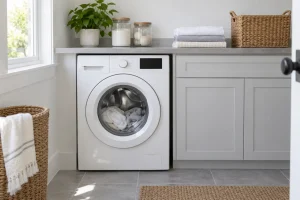
A washer fails in ways you can hear, smell and see on the floor, and each of those clues points to a different part of the machine. Electrolux front-load and top-load washers in San Francisco flats, condo laundry closets and Bay Area basements all follow the same basic path: water comes in through the inlet valves, the control board reads the water level through a pressure sensor, the drum or agitator turns through a motor and drive, and a drain pump sends the water away. A fault anywhere along that path can look like something else, which is why we start with the symptom and work backward to the part.
If the washer fills slowly, stops filling, or runs a cycle with too little water, the question is whether water is not arriving or the machine believes it already has enough. A kinked hose, a clogged inlet screen, a weak inlet valve or a confused pressure sensor all produce the same complaint. A washer that fills and drains right away may be misreading its level. Our post on a washer that fills and then drains walks through that pattern in detail.
Clothes come out soaked or the door will not release. Usual suspects are a clogged coin trap or drain filter behind the lower panel, a drain hose pushed too far into a standpipe, a drain pump that hums without moving water, or a sensing problem that tells the board the drum is still full.
A washer that thumps, knocks or shuffles across the floor during spin is usually dealing with an unbalanced load, an unlevel base, a worn suspension part or a bearing that has started to fail. See washer keeps rebalancing during spin and knocking at high spin speed for the owner-side checks.
Front-load washers lock the door during a cycle and release it afterward. When the door stays locked after the cycle ends, or the washer refuses to start because it thinks the door is open, the latch assembly, its switch or the board that reads it may be involved. See door stays locked after the cycle before anyone pries on it.
Detergent left in the drawer or a sour smell at the door seal usually comes from water flow, load size or a seal that never dries; detergent left in the dispenser separates those causes from a weak fill.
We ask what the washer did right before it stopped, which cycle was running, whether the problem happens with every load, and whether anything changed recently, such as a new hose, a moved unit or a different detergent. Then we confirm the symptom ourselves, read any code on the display, check the supply side and the drain side, and test the suspect part before suggesting a replacement. You get a written estimate that names the cause we found, and nothing is repaired until you approve it.
Electrolux washers show codes that start with E or EF, and the same letters can appear with a different first character on some boards. Write the code down exactly as shown, including any letters that follow the digits, then compare it with the list. A few that come up often: E11 points to a fill that took too long, E21 to water not leaving fast enough, E13 to a leak in the tub or a problem with the pressure sensor, EF5 to an unbalanced load, EF2 to too much soap or the wrong type, and E42 to a door lock device failure. A code names a symptom or a circuit; it does not by itself prove a part is bad. The full set is on the error codes index.
Many San Francisco washers sit in a hallway closet or garage corner where the floor is old or slightly sloped. A floor that flexes during spin makes a good washer look unbalanced. Drain setup matters just as much: a hose that sits too low can siphon water out during the fill, which looks like a fill fault, while a standpipe that is too narrow or partly blocked slows every drain. Check where the drain hose enters the standpipe and whether the supply valves in the wall open fully.
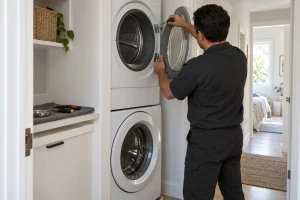
Front-load models add a door seal and lock; top-load models rely on a lid switch. Stacked pairs can be tight to service. Towers have their own page, Electrolux laundry tower repair.
Do not open the back or top panel, do not test wires, and do not bypass the door switch to force a cycle.
Turn the washer off at the breaker and close the supply valves if you see water leaking from the cabinet, a burning smell, sparks, a hot control panel or a drum that grinds loudly. Do not run repeated cycles hoping it clears; a leaking washer can damage flooring and the unit below you.
Electrolux uses the same cabinet styles across several series, but the board, motor control and sensor layout change between them. The label usually sits inside the door frame or along the edge of the door opening on a front-load washer, and on the rim or inside the lid area of a top-load washer. Some listings in the Electrolux range, such as the ELFW7626 family, are shown by a base number and the last letters on your label vary by finish or version. A model like the ELFW7637AT in the 600 Series, which lists SmartBoost, is handled differently from a basic top-load such as the ELVW7405AW. The full label avoids a wrong part.
You send a request with the washer type, the symptom and the model label if you can read it. We confirm the address, agree on a window and look at the machine in place. We test, explain the finding in plain language and write up an estimate; you decide whether to go ahead.
The lineup and label locations are on Electrolux washers. A paired dryer is covered under Electrolux dryer repair.
The washer pauses when it cannot drain, cannot lock the door or detects a sensing fault. Check the drain filter and the hose position, note any code shown, and book a visit if the water stays in the drum.
Wait until the drum has drained and the lock has had time to release. If the door stays locked with an empty drum, do not force it, because a broken latch makes the repair larger.
No. Leaks can come from a hose connection, the door seal, the dispenser, the pump housing or the tub. We trace the water to its source before suggesting a part.
Yes. We repair front-load and top-load Electrolux washers across San Francisco and the Bay Area, including units in closets and stacked setups.
The full model label, the code on the display if any, a short description of when the problem happens, and clear access to the washer, its hoses and the wall valves.
Electrolux front-load and top-load washers by series, where the label is, the display codes and safe checks before you book a repair.
Electrolux induction and gas cooktop repair in San Francisco and the Bay Area, from rejected pans and dead zones to igniters and…
Electrolux dishwashers that leave dishes dirty, hold water or show a code, diagnosed under tight Bay Area cabinets with a written estimate…
Electric and gas Electrolux dryers with no heat, long cycles, odd noises or early stops, checked from the vent to the drum…
Soft food, heavy frost, a pooling drain or a loud fan: Electrolux freezers diagnosed and repaired across San Francisco and the Bay…
No ice, thin cubes, a jammed chute or water on the floor: Electrolux ice makers traced from supply to mold across San…
Stacked Electrolux washer-dryer towers, electric or gas, repaired in closets and hallways around San Francisco and the Bay Area, one half at…
Repair for Electrolux built-in drawer and side-swing microwaves in San Francisco and the Bay Area, covering no heat, door latches and display…
Diagnosis for Electrolux dual-fuel and induction ranges in San Francisco and the Bay Area, from burners and zones to oven heat and…
Warm compartments, leaks, noises, dispenser trouble or a flashing code: diagnosis and repair of Electrolux refrigerators across San Francisco and the Bay…
Repair for Electrolux single and microwave-combination wall ovens in San Francisco and the Bay Area, covering heat, fans, door latches and displays.
Temperature swings, a cooler that stays warm, fogged glass or noisy fans: Electrolux wine and beverage coolers serviced across San Francisco and…
Share a few details and we’ll confirm an appointment. Prefer to talk? Call us and we’ll help right away.